Getting more from homegrown feed is top of mind for many dairy farmers. One of the simplest and most effective ways to increase feed production is to improve clover establishment and management in perennial pastures.

Article
Getting more from homegrown feed is top of mind for many dairy farmers. One of the simplest and most effective ways to increase feed production is to improve clover establishment and management in perennial pastures.
White clover does more than fill gaps in a sward. It improves feed quality in late spring and summer, supports milk production as ryegrass quality declines, and fixes its own nitrogen naturally. For systems that calve early and rely heavily on pre-Christmas milk, clover becomes especially valuable for maintaining quality and reducing the need for costly supplements as summer pressures increase and production becomes more difficult.
Successful clover stands begin at sowing. Clover seed needs to be sown shallow and the seedbed well consolidated. Deep sowing remains one of the most common causes of poor establishment, particularly when clover is mixed with ryegrass seed which is more tolerant to variable sowing depth. Broadcasting can also perform well, provided seed-to-soil contact is strong and the surface is firm.
While germination is often fast for clover seedlings, they can appear slow in comparison to ryegrass. Much of their early energy goes underground into a tap root development which leaves them vulnerable to shading. During this phase, companion grasses often outcompete clover for light, so careful management is needed. Grazing rotations that open up the pasture canopy and let light reach the base will support future clover content, especially important through winter and autumn when grasses can grow faster than the clover.
Early and regular grazing is key to opening the pasture canopy. This also applies through winter and early spring, when companion grasses tend to surge ahead. Allowing excessive shading at this stage can significantly reduce summer clover content.
Autumn saved pasture is another pressure point. While longer covers are often necessary, repeated shading events reduce stolon survival. Following saved pasture with tighter grazing to reset light levels is essential for keeping clover in the mix.
Clover responds strongly to good soil fertility and is more sensitive to nutrient shortfalls than ryegrass. Target a soil pH of 5.8–6.2 and ensure adequate levels of phosphorus, potassium, sulphur and molybdenum.
When nutrient levels are optimised clovers can contribute more reliably, supporting a natural nitrogen cycle and maintaining pasture productivity and pasture quality.
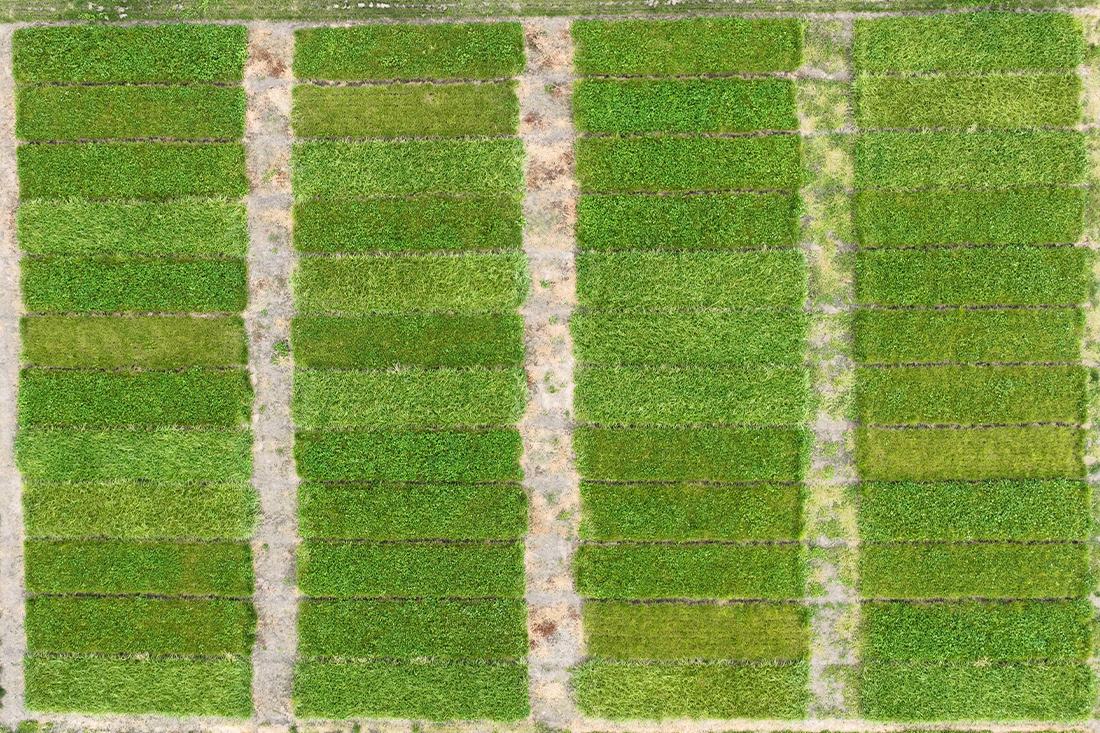
Recent trials highlight the lift modern clover genetics can bring. In Agricom’s White Clover Advantage trial, cultivars such as Brace and Attribute delivered between 2.4-3.5 t DM/ha more dry matter annually when sown with perennial ryegrass1, compared with older cultivars of white clover sown with the same grass.
These modern varieties have been bred to perform strongly in dense ryegrass pastures supporting farmers reaching production targets often with reducing nitrogen use.
Agricom’s Brace stands out for its large leaves, persistence, and reliable shoulder-season growth. At the same time, Attribute performs well in intensive dairy pastures, making it a versatile base for mixed pastures.
Combining modern clover cultivars with good establishment and thoughtful grazing can deliver more high-quality feed and better pasture efficiency. With the added benefit of improved nitrogen cycling, white clover remains one of the most cost-effective ways to build resilience and productivity into New Zealand pasture systems.
For advice on clover establishment and management, talk to your local TSR.
1. Agricom. (n.d.). The numbers stack up: NZ bred proprietary clover from Agricom [Web page]. https://www.agricom.co.nz/trials
Article supplied by Agricom