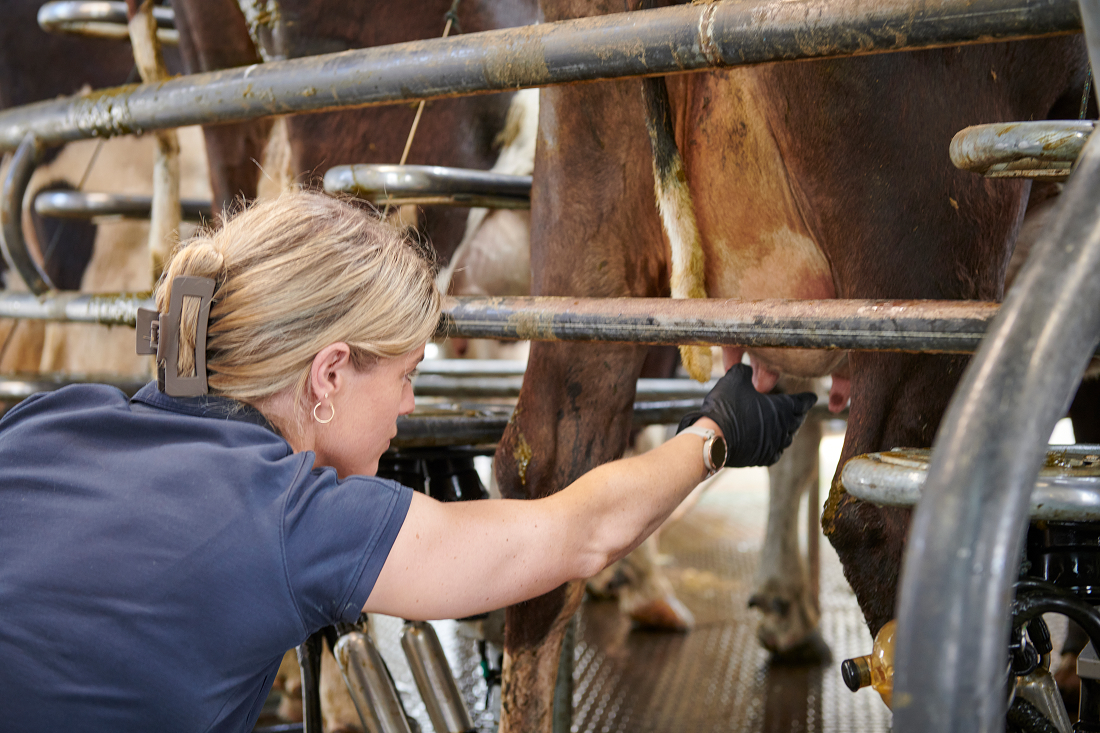
The Co-op’s Milk Quality Managers work nationwide, providing farmers with independent advice on reducing bulk somatic cell counts, improving efficiency in the milking shed, and increasing productivity. We talk to Dannevirke-based Milk Quality Manager Jess Galloway about the role.
I grew up on a sheep and beef farm just out of Wellington. My partner and I live on a sheep and beef farm in Dannevirke with my two boys. Life is pretty full on, as you can imagine, with six and eight-year-old boys, along with horse riding, sports, farming, and exercise – I’m also currently training for a charity boxing match with Fonterra as my sponsor (part of the Doing Good programme).
Despite being surrounded by sheep and beef cattle, the dairy industry has always interested me. After graduating from Massey University with a degree in agribusiness, I started working for QCONZ as a farm dairy assessor. It provided a lot of training, and I have really appreciated that investment throughout my career. It has helped me immensely as a Milk Quality Manager at Farm Source. Whether it’s plant hygiene issues or water quality, a lot of the advice I give today stems from my knowledge from QCONZ and training.
I joined Farm Source in 2020, initially as a Sustainable Dairying Advisor, which I enjoyed, but when a role opened up in the milk quality space, I jumped at it. I work with farms spanning Hawke’s Bay, Wairarapa, and Manawatu. It’s a vast area with farms spread out – it’s around three and a half hours’ drive to my furthest farms. There is a lot of diversity within the region, from big corporate farms with multiple staff to smaller owner-operated farms. I’ve loved seeing the role evolve more into a proactive space. Farmers now recognise that when we call, it’s to support them rather than simply compliance. I’ll work proactively with farm teams to help improve milk quality and production, reduce somatic cell counts, and support efforts to reduce emissions. The role also really loops in well with the other Farm Source teams.
I find that farmers are always looking to improve, even if the farm is in a good space. My top tips: Having a good teat spray system in place that is checked and calibrated is really useful. Ensuring everyone on the farm is vigilant and knows how to identify mastitis cases is crucial.